Mocap
↗jkloers/mocapWhat it is
What if a room full of people dancing could generate music in real time, together, as a collective instrument?
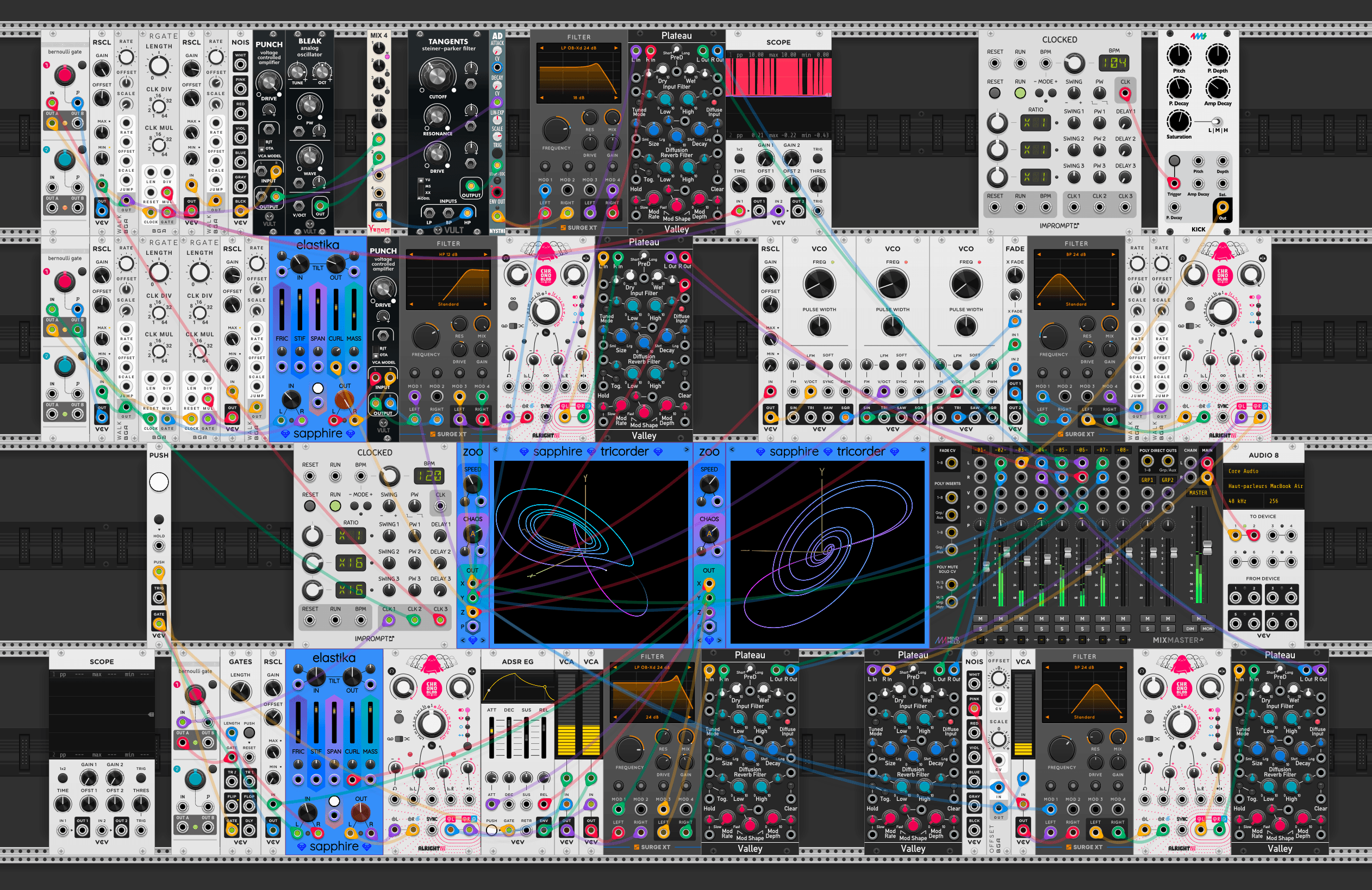
That's the premise. Everyone carries a smartphone. As they move, their phones stream motion data to a server, which feeds a Max/MSP patch, which modulates the control voltages of a modular synthesizer built in VCV Rack. The whole group becomes a single, distributed instrument.
This was built in collaboration with the Center for Robotics and performed during a workshop at Universidad Politécnica de Madrid. One of the most alive projects I've worked on.
The Pipeline
Phone → server → Max/MSP → Ableton → VCV Rack.
If you're not familiar with modular synthesis: instead of playing notes, you build a circuit of modules (oscillators, filters, envelopes, sequencers) and connect them with virtual cables. Sound is generated and shaped entirely through voltage signals. This makes it ideal for continuous, expressive control driven by body movement.
On top of that, we integrated two additional layers. RAVE, a variational autoencoder trained on a sound corpus, handled real-time timbre generation and transformation. An HNN took care of motion recognition, letting the system distinguish between different types of movement rather than just raw acceleration.
Storm simulator. The final version, and the one we performed. I went through acoustic research to understand the physics of thunder and rain: the frequency envelopes of a distant rumble, the stochastic texture of rainfall, the sharp transients of a strike. The collective movement of the room became the storm's conductor: stillness brought silence, density brought rain, synchronized motion could trigger lightning.